

Senua AI Cyber
Stop bad bots, AI scrapers and rogue AI agents on your own servers.
Senua AI Cyber learns how your websites and systems normally behave, then stops or flags whatever does not fit. It runs on hardware you already own. No models, no GPU and no AI token costs. The price does not move when you get attacked.
Senua AI Cyber
Senua AI Cyber product range
What the four products do, what they need to run, and why there are no AI token costs to pay. We do not use models. No LLMs. No SLMs. Of any kind.
The problem
Most of your web traffic is not human.
Bots now make most of the requests on the web, and AI has made them cheaper to build and harder to spot. They scrape your content, try stolen passwords, abuse your APIs and flood your sign-up and checkout pages. Your bill and your customers pay for it.
Bot attacks and traffic surges
Automated traffic passed human traffic in 2024: 51% of all web requests, and 37% came from bad bots. A surge can take down a login, a ticket sale or a sign-up page in minutes. Source: Imperva 2025 Bad Bot Report.
AI scrapers and crawlers
AI crawlers made 4.2% of all HTML requests in 2025, taking your content to train and feed AI products, often without sending visitors back. Source: Cloudflare Radar 2025 Year in Review.
Rogue AI agents
AI agents now browse, fill in forms and fetch files for people. Bots acting on people's AI requests grew more than fifteen times in 2025 (Cloudflare Radar 2025 Year in Review). In June 2026 an AI agent took files it should not have from a Services Australia portal, and the department was told 84 days later (ABC News, 24 September 2026).
Credential stuffing and account takeover
Bots try leaked passwords against your login until one works. On a typical day about one login attempt in five is exactly this (Verizon 2025 Data Breach Investigations Report). In April 2025 one such attack took at least $500,000 from members of five Australian super funds.
Why the usual defences miss them: CAPTCHAs, rule lists and bot blocklists judge one request at a time, and an AI agent can make each request look human and claim to be anything. What gives a bot away is how it behaves across many requests, compared with your real visitors. That is what Shield reads.
Measured on real attacks
What Shield does to an attacking source.
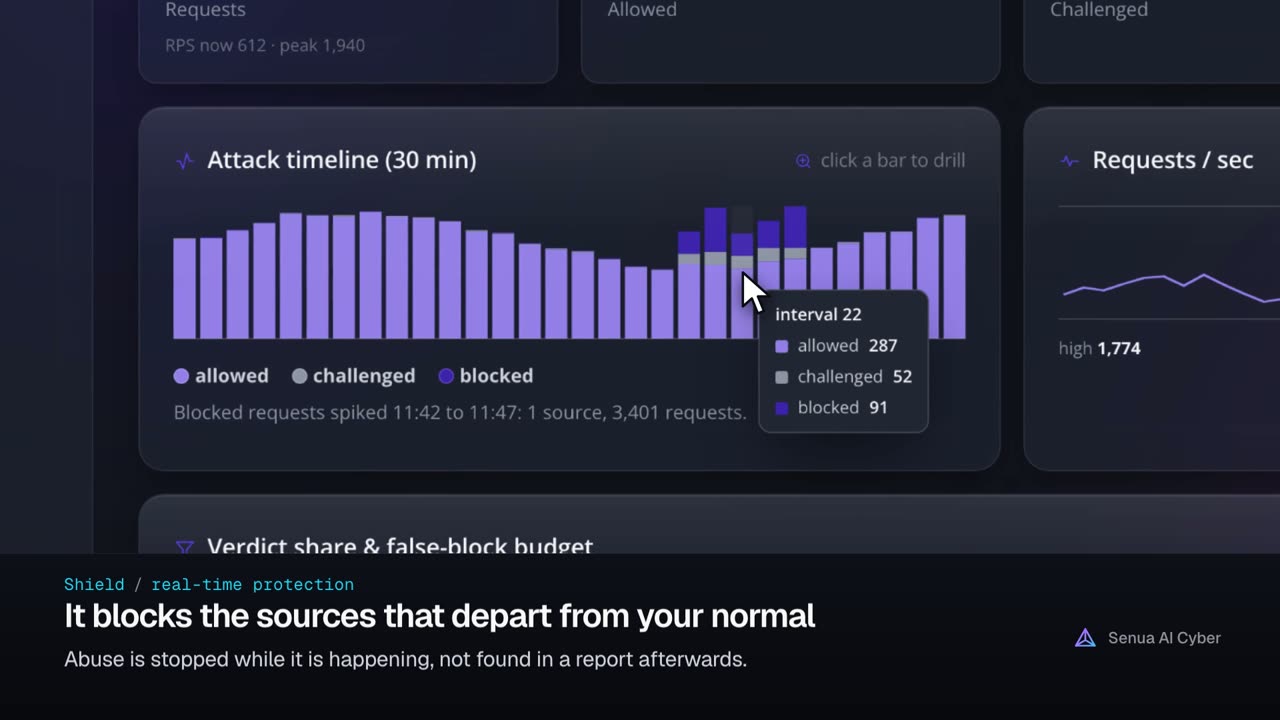
Shield does not act on one odd request, because that would block real visitors. It watches each source's requests and blocks it once they agree it is not behaving like your visitors.
of attacking sources blocked by their third request
CSIC 2010, 25,065 attacks
of 6,000 genuine sources wrongly blocked
CSIC 2010, 6,000 normal sources
of attacking sources blocked by their tenth request
CSIC 2010, a public web attack dataset
And against an AI agent: in our public showcase, a reconstruction of the portal in the Services Australia incident with simulated traffic, Shield stopped the agent from its third request, and blocked every request when it switched addresses, without blocking any of 600 legitimate visitors. See the showcase.
- No rules to write
- Runs on your hardware
- No traffic leaves your network
- Flat price during an attack
- One console
The range
Four products, one console.
Each product watches a different part of your systems and asks one question: is this behaving the way it normally does? Run one, or all four as Cyber Unlimited.
Shield: bot and AI agent defence
A self-hosted alternative to Cloudflare Bot Management and DataDome
Stops bad bots, AI scrapers, credential stuffing and API abuse before they reach your application. It learns how your real visitors behave, blocks a source once its requests show it is not one of them, and tells you why.
Read about Shield ->Pulse: uptime and response times
A self-hosted alternative to Pingdom and UptimeRobot
Tells you when a website, API or service starts to slow down or fail, before your customers notice. It learns each endpoint's normal response times, so there are no thresholds to set.
Read about Pulse ->Discern: log anomalies and intrusions
A self-hosted alternative to Splunk and Elastic anomaly detection
Reads your logs and raises an alert when they stop looking normal: an intrusion, an error storm, a bad deployment. No rules or query language to learn, and every alert shows the log lines behind it.
Read about Discern ->Vitals: server and database health
A self-hosted alternative to Datadog infrastructure monitoring
Watches the gauges your servers already report (hosts, databases, web servers, queues, caches and containers) and flags the one that stops behaving like itself. No thresholds to set.
Read about Vitals ->Your data stays with you
Your traffic never leaves your network.
Most bot protection is a cloud service: to be protected, your traffic goes through the vendor's network. For a government agency, a bank, a health service or anyone bound by data residency, that is often a hard no.
Senua AI Cyber runs on your own servers, in your own account and your own region. It can run fully offline: the licence is a signed file you install, with no call home and no outbound connection to allow through your firewall.
There is no threat feed to subscribe to, because nothing here depends on one.
Where your traffic goes
| Vendor | Where your traffic goes |
|---|---|
| Cloudflare, DataDome, HUMAN, Kasada, Imperva | Through the vendor's network. Cloud only. |
| AWS WAF Bot Control | Through your cloud provider's edge. |
| F5, Wallarm, SafeLine | Stays with you, but runs on rules or signatures you maintain. |
| Senua AI Cyber | Stays with you, with nothing to tune. |
From published vendor pricing and the vendors' own product documentation.
No surprise invoices
Your bill should not spike during an attack.
Most bot protection is priced by traffic. An attack multiplies your traffic, so the month you were attacked is your most expensive month. We charge a flat price instead.
Priced by traffic
- Billed on requests or bandwidth
- An attack inflates the bill
- Overage lands on the same invoice as the incident
- Budgeting means forecasting your attackers
For comparison: DataDome Essentials starts at about AUD $5,900 a month (published as USD $3,830) and is priced by traffic; Cloudflare Bot Management is a quote-only enterprise add-on.
Priced flat
- Shield is AUD $1,799 a month, flat, for up to 10 sites
- Traffic is never metered
- An attack changes your graphs, not your invoice
- Annual is 10 months' price, so two months are free
Prices include GST.
Nothing to tune
The licence is not the expensive part. The tuning is.
A managed, rule-based web application firewall costs $27,000 to $39,000 a year per customer in rule tuning, false alarms and onboarding: about 200 hours of an engineer's time, plus the night a rule update blocks real customers.
Nothing to write
No signatures, no rule packs and no thresholds. Normal is learned from your own traffic, so there is no policy to keep up to date.
Nothing to re-tune
There is no vendor rule feed to check against your application every week. Overrides exist for the exceptions, not as the way you run it.
One setting, and it is yours
Your false-block budget: how many genuine visitors you are willing to risk blocking. Shield sets its block level from that and shows it to you.
Upkeep figures from Indusface's published managed-WAF operating costs.
Pricing
Flat, published, in Australian dollars.
Every plan is flat, self-hosted and never metered. If a licence lapses you get 3 days before the instance goes read-only, and your data is never deleted.
- Pulse, Discern or Vitals
- Flat per product
- Annual: 10 months' price
- Less than the $2,396 sum
- Every product enabled
- On-Prem: AUD $60,000 per year
Prices include 10% GST. Enterprise, large fleets and sovereign deployments are priced per deployment: Contact us.
Who it is for
Built for organisations that cannot send their traffic to someone else.
Government agencies, the defence supply chain, banks, super funds, health services and critical infrastructure. And online businesses that have been hit with a bill for an attack and want a flat, self-hosted price instead.
Run it on your own hardware.
Nothing is routed through us, and no traffic leaves your network. Prices are published in Australian dollars and do not move with your traffic. Tell us what you need to protect.